
EB-2 Employment Visa

The EB-2 visa is an employment-based green card option for professionals with advanced degrees or exceptional ability in the sciences, arts, or business. To qualify, you generally need a master’s degree (or a bachelor’s degree plus five years of progressive experience) or strong evidence that your expertise places you well above others in your field. Many EB-2 cases require employer sponsorship and a labor certification, but the National Interest Waiver (NIW) allows certain applicants to self-petition if they can show their work has substantial merit and national importance to the United States. For entrepreneurs, researchers, physicians, engineers, and other highly skilled professionals, the EB-2 category can be one of the most strategic paths to permanent residence. Timing depends on USCIS processing and visa bulletin availability, which varies by country of birth, but a strong case is built on clear legal positioning and persuasive documentation. Whether pursuing a traditional employer-sponsored EB-2 or a self-petitioned NIW, applicants must demonstrate not just qualifications, but why their continued work benefits the United States. Choosing the correct category and presenting a well-structured petition can significantly affect overall processing time and long-term success, making early strategic planning essential for anyone considering this pathway to a U.S. green card.
Fiancé(e) Visa vs. Spouse Visa: Which Immigration Path Is Right for You?
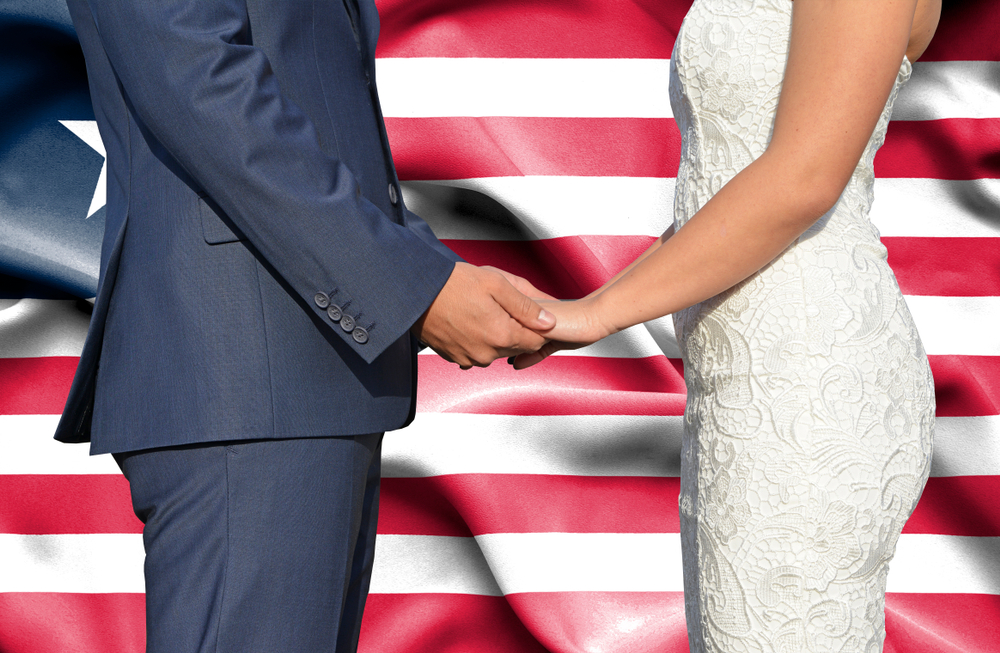
If you’re in a relationship with a foreign-born partner and planning a future together in the United States, one of the first questions you’ll face is how to immigrate as a couple. For U.S. citizens, the two most common options are the K-1 fiancé(e) visa and the spouse immigrant visa (CR-1 or IR-1). While both ultimately lead to a green card, they differ significantly in timing, cost, work authorization, and overall stability. Understanding these differences upfront can save months of frustration—and thousands of dollars. The K-1 Fiancé Visa: Marry in the U.S. The K-1 fiancé visa allows a U.S. citizen to bring their foreign fiancé(e) to the United States for the purpose of marriage. Once the fiancé(e) enters the U.S., the couple must marry within 90 days, after which the foreign spouse applies for a green card through adjustment of status with U.S. Citizenship and Immigration Services. The main advantage of the K-1 is earlier physical reunion, since the couple does not need to marry abroad before starting the process. However, the tradeoff is significant: the K-1 holder cannot work or travel immediately upon arrival and must go through a second, lengthy immigration process after marriage. In practice, it often takes 18–30 months from filing to receiving a green card, making the K-1 more expensive and procedurally complex than many people expect. The Spouse Visa (CR-1 / IR-1): Marry First, Enter as a Resident With a spouse immigrant visa, the couple marries first, and the U.S. citizen files a petition for their spouse. The foreign spouse typically remains abroad during processing and enters the U.S. already as a lawful permanent resident, with full permission to work and travel from day one. If the marriage is less than two years old at the time of approval, the spouse receives a CR-1 (conditional resident) card; if the marriage is two years or older, the spouse receives an IR-1 (immediate relative) card. Although this route may involve a longer period of physical separation, it is generally cheaper, cleaner, and faster to permanent status, with total processing time usually around 12–18 months and no adjustment of status required after entry. Key Differences at a Glance K-1 fiancé(e) visa: Faster reunion, but no immediate work or travel authorization and a longer path to a green card. Spouse visa (CR-1/IR-1): Slower reunion, but immediate stability, lower overall cost, and fewer procedural steps. Which Option Is Better? For most couples who can marry first, the spouse visa is the stronger option. It minimizes legal limbo, reduces cost, and provides immediate work authorization upon entry. The K-1 remains a valid choice when marrying abroad is impractical or impossible, but it is best understood as a convenience-based option, not a faster path to permanent residence. Final Takeaway Choosing between a fiancé(e) visa and a spouse visa is not just about where the wedding takes place—it’s about how long you’re willing to wait for stability. Couples who understand these tradeoffs early can make informed decisions that align with their priorities, finances, and tolerance for separation. If you’re unsure which path fits your situation, a case-specific analysis can help you avoid delays and choose the most efficient strategy for building your life together in the United States.
EB-2 Visas: Who Qualifies and How the Process Works
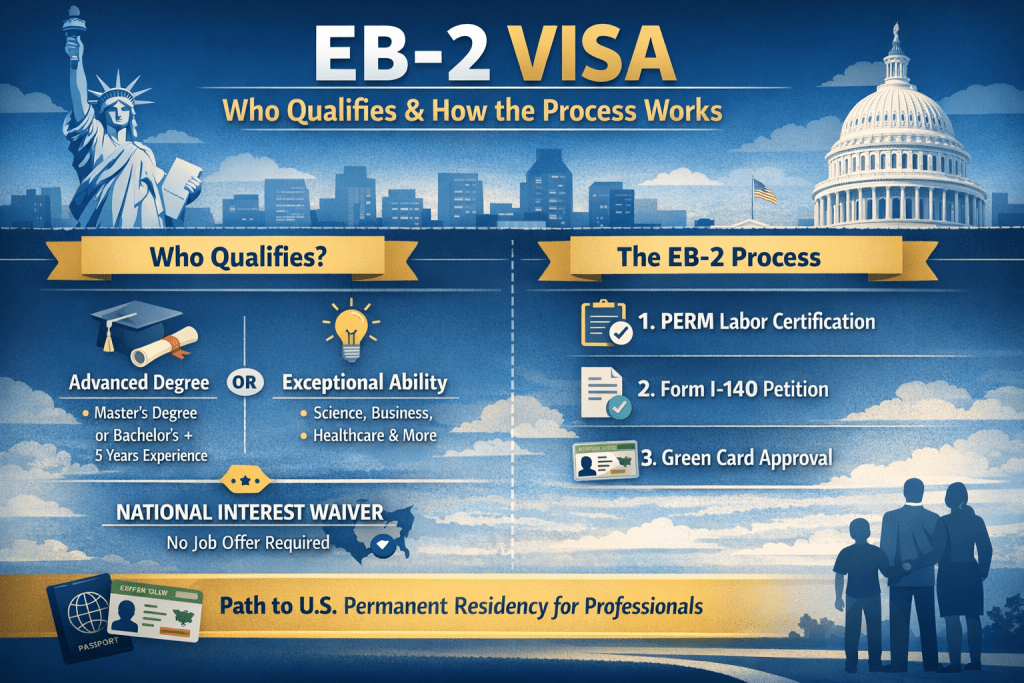
What Is the EB-2 Visa and Who Qualifies? The EB-2 visa is an employment-based immigrant category that leads directly to a U.S. green card for professionals with advanced degrees or exceptional ability in fields such as science, business, healthcare, education, and technology. Applicants may qualify either through a U.S. employer-sponsored position (typically requiring a master’s degree or a bachelor’s degree plus five years of progressive experience) or through the EB-2 National Interest Waiver (NIW), which allows qualified individuals to self-petition without a job offer if their work benefits the United States. The EB-2 is widely considered one of the cleanest and most reliable paths to permanent residence for highly skilled professionals. Many people undervalue their skill-set and do not see themselves as “highly skilled professionals” but they are often wrong, especially if you used to work for USAID… if you were hired as a professional in USAID, you very likely qualify. How the EB-2 Process Works In an employer-sponsored EB-2 case, the process generally begins with a PERM labor certification, where the employer must prove that no qualified U.S. workers are available for the position, followed by filing an immigrant petition and a green card application. By contrast, the EB-2 NIW bypasses the labor certification entirely, focusing instead on the applicant’s qualifications, proposed work, and its national importance. Once approved, EB-2 applicants and their immediate family members may obtain lawful permanent residence and, after five years, become eligible for U.S. citizenship. Because timelines and requirements vary, careful case strategy is essential to maximizing approval and minimizing delays.
Facts Should Matter: Immigrants are not responsible for America’s crime problem
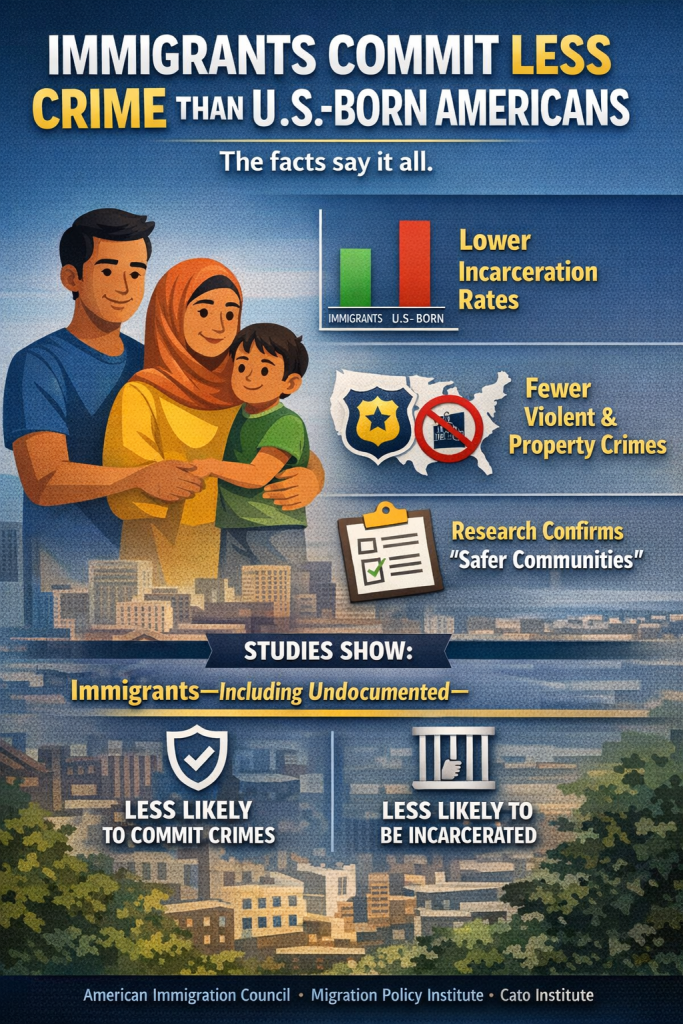
Despite persistent political rhetoric, decades of research consistently show that immigrants commit crime at lower rates than U.S.-born Americans. The Anti-Immigrant crowd love to frame the discussion around the title they have given to immigrants as “illegals.” Whether they are being purposely misleading for their political ambitions or are just stupid, the term is completely inappropriate. Immigration law and enforcement is an administrative process. Human beings can have an “illegal status” but they are not, by nature, “illegal.” If you violate immigration law, you will not have a criminal record. It is not a criminal act, despite what certain pundits will try and tell you. Add to that, the vast majority of immigrants commit no crimes and are upstanding and contributing members to building a stronger better country. Alas, stupid people need someone to blame for their shortcomings; hence, they attack immigrants. So lets look at the actual facts from several different sources. One of the clearest summaries comes from the American Immigration Council, which reviewed national and local studies and found no evidence that immigration increases crime. In fact, many studies show the opposite: communities with higher immigrant populations often experience lower rates of violent crime. Similarly, the Migration Policy Institute reports that immigrants—regardless of status—are less likely to be incarcerated than native-born citizens. These conclusions are based on large-scale analyses of Census data, FBI crime statistics, and state incarceration records. Economists at the Cato Institute have gone further, comparing incarceration rates directly. Their findings show that undocumented immigrants are significantly less likely to be incarcerated than U.S.-born Americans, and even less likely than native-born citizens without a high school diploma. Stanford researchers have reached similar conclusions, noting that immigrants have had lower incarceration rates than the U.S.-born population for more than a century, including during periods of high immigration. Why does this myth persist despite overwhelming evidence? Part of the answer lies in how immigration enforcement data is misused. Immigration arrests are often conflated with criminal arrests, even though the vast majority of immigration violations are civil, not criminal. In immigration court, you “affirm or deny”, you do not plead “guilty or not guilty.” Another factor is selective anecdotal reporting—isolated crimes committed by noncitizens are amplified to suggest a trend that simply does not exist in the data. The takeaway is straightforward: immigration does not drive crime. Policy debates should be grounded in evidence, not fear. When lawmakers and commentators claim that immigrants make communities less safe, they are contradicting a well-established body of research. The facts tell a different story—one in which immigrants are, on average, more law-abiding than the native-born population and contribute to community stability rather than insecurity. So when Trump says they are “rounding up the worst criminals”, he’s talking about moms, children, your neighbor… just regular people seeking a better life, just like all of our ancestors did at one point. There are lawful pathways to immigration status and each of these people should be given the opportunity to seek those options and not be treated like criminals. They are human beings who deserve, at the very least, modicum of respect.
The Cruelty of Suspension: How the Trump Immigration Crackdown Breaks Families and Betrays American Values

Just when many of us hoped the worst instincts of U.S. immigration policy were behind us, the latest announcement on immigrant-visa suspensions feels like a painful return to an era of exclusion and fear. More than 70 countries — including places like the Democratic Republic of the Congo, Nepal, Haiti, and Nigeria — will see immigrant visa processing halted. That means thousands of hardworking people, loving partners, and children waiting to reunite with family in the United States are suddenly pushed back into uncertainty. The administration claims this decision is about “improving vetting,” but the real effect is simple: shutting the door on human beings who just want a better life. A Policy Built on Fear, Not Facts Let’s be clear: no society is supposed to base its entry rules on fear and suspicion. Yet this suspension is rooted less in data and more in political posturing. It echoes the worst policies of the Trump era, when entire groups of people were labeled “dangerous” simply because of their nationality or religion. What we’re seeing now is that same playbook updated for the modern moment — a broad, blanket restriction that looks tough but serves only to punish the innocent. This isn’t about security. Real security comes from targeted investigations, smart intelligence, and cooperation with international partners — not blanket bans that sweep up families and dreamers in the same net as those who might pose real threats. The Human Cost: Dreams Deferred, Families Torn Apart For every number in this policy announcement, there’s a human story: A wife in Ghana waiting years to join her husband who works long hours to support their children. A talented engineer from Bangladesh whose U.S. employer has already sponsored him — now stuck in limbo. A young activist from Haiti fleeing violence, trying to rebuild a life with relatives in the United States. These are not abstract “cases.” They are people whose lives are disrupted by arbitrary lines on a map and sweeping policy decisions made far from their realities. The Message We’re Sending to the World America has long built its global identity on being a beacon of hope — a place where people can strive, contribute, and build families without fear of being summarily excluded. When we suspend immigrant visas for whole nations, we send a message that success and belonging are reserved only for some people, while others are kept waiting indefinitely. This is not the America of the Constitution’s promise. It is not the America of immigrants who built industries, communities, and culture. It’s a version of America that looks inward, afraid of change, and unwilling to live up to its own ideals. A Call for Real Reform, Not Discrimination If the administration truly wants to improve the immigration system, it should: Invest in case backlogs and processing capabilities, not punish applicants with needless suspensions. Expand legal pathways for family reunification, humanitarian protection, and worker visas. Reject policies that stereotype entire populations based on nationality. People deserve individualized adjudication, not blanket bans. Our immigration policy should reflect justice, dignity, and respect for human rights, not fear-based exclusion. Final Thoughts Policies that close doors, separate families, and marginalize entire nations are not strength. They are weakness masquerading as strength — a retreat from our values at a time when the world needs leadership grounded in fairness and compassion. Immigration reform should lift people up, not shut them out. And until that day comes, activists, advocates, and everyday Americans must continue to speak out against policies that undermine what makes the United States truly great.
America’s Immigration Crisis Is a Moral Crisis — And Trump’s Policies Are Making It Worse
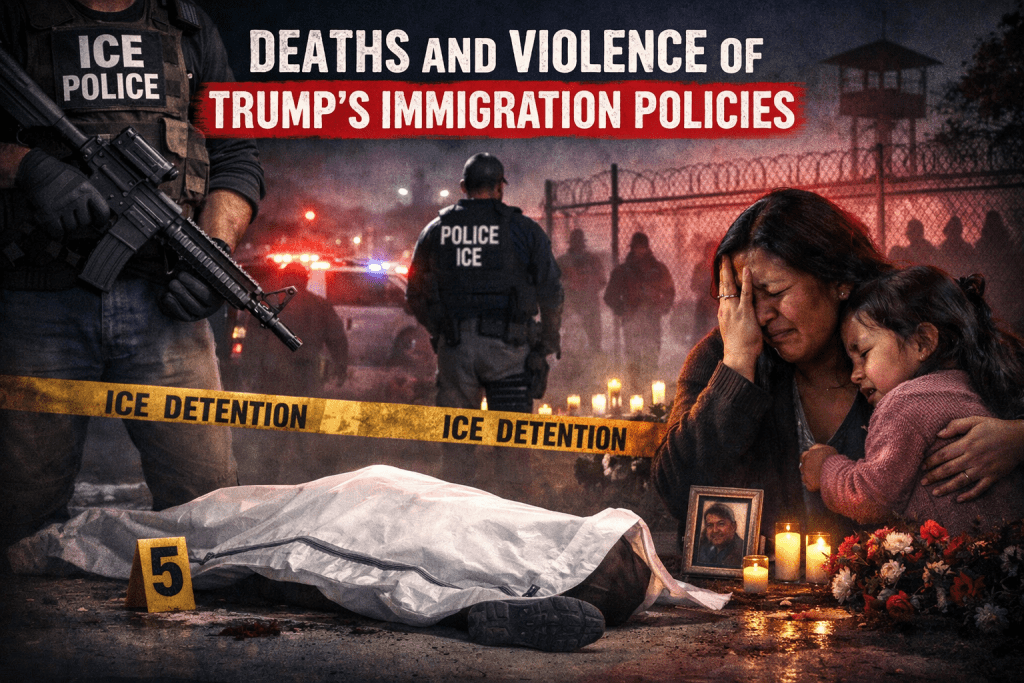
I hate writing this. I would not recommend it, but I watched the video of an ICE agent fatally shooting an American civilian who posed no threat to him. She was actively complying with officers’ instructions when she was shot. On January 7, 2026, 37-year-old Renee Good was killed by an ICE agent during a Minneapolis operation, a shooting later defended by former President Trump and Department of Homeland Security officials as “self-defense.” Eyewitness accounts and video footage, however, show an unnecessary and reckless use of deadly force. This was not an isolated incident. It is part of a broader and deeply troubling pattern in which immigration enforcement operations have resulted in shootings and deaths amid intensified raids and aggressive enforcement tactics. Meanwhile, political leadership—up to and including Trump—simply rewrites the narrative, denying what plainly occurred. These deaths are not tragic accidents or unavoidable anomalies. They are the predictable outcomes of immigration policies that prioritize arrests, detention, and deportation over human safety and dignity. Under Trump’s leadership, the immigration system became increasingly punitive, relying on mass detention and militarized enforcement rather than humane, evidence-based practices that protect life and preserve families. The Trump administration has repeatedly framed these deaths as unfortunate but inevitable consequences of enforcing immigration law. That framing is false. Policy choices matter. Decisions to expand detention capacity, escalate armed enforcement operations, and treat nearly any perceived resistance as justification for lethal force have transformed immigration enforcement into a crisis of state violence. These are not statistics or abstractions. They are people killed, families devastated, and communities left searching for accountability. If the past year has made anything unmistakably clear, it is this: an immigration system without compassion is not merely unjust—it is deadly.
ICE Facilities: Negligently Killing Our Neighbors

ICE FACILITIES RANK 5th GLOBALLY IN KILLING RESIDENTS The Trump administration’s aggressive immigration enforcement has produced a grim and largely hidden toll: in 2025 alone, at least 32 people died while in Immigration and Customs Enforcement (ICE) custody, making it the deadliest year for the agency. ICE has about 68,000 human beings detained, 75% of which have NO CRIMINAL RECORD, and 32 of them died from completely preventable causes. That makes ICE’s current death rate at 46.8 per 100,000 people. To put this in perspective, if ICE was a country, they would have the 5th highest murder rate in the world. I understand that they didn’t intentionally shoot them all, but they are purposely overcrowding facilities (at 140% capacity in Dec 2025), withholding medical care and other basic services. The intent has always been to traumatize a class of “others” and this behavior has been intentionally malicious resulting in a high death toll. HUMAN BEINGS ARE NOT JUST STATISTICS The people who died were not statistics; they were asylum seekers, longtime lawful residents, DACA recipients, parents, workers, and community members. Many reported severe medical symptoms—seizures, chest pain, respiratory distress—only to have their pleas for care ignored or delayed. The administration insists that detention conditions meet medical standards, yet advocates, lawyers, and families paint a starkly different picture of overcrowded facilities, inadequate care, and systemic neglect driven by a policy choice to detain as many people as possible, regardless of risk or humanity. ALL OF THIS WAS/IS PREVENTABLE What makes these deaths especially troubling is that they were foreseeable and preventable. For many MAGA believes, the anger against the “others” is real, but most would stop before wanting those “others” to actually die. That is a bridge too far for most Americans, which makes this approach particularly troubling for an administration, for as much as they refuse to accept this, that MUST represent all of America and not just the MAGA maralagoites. As detention expanded under Trump-era policies, warnings from human rights groups went unheeded, even as people died of untreated illness, suicide, or medical emergencies during transport or shortly after detention. The stories from 2025—from asylum seekers who had been in the country only days to immigrants who had lived in the U.S. for decades—underscore a fundamental failure of policy and oversight. Detention became the default, not the last resort, and the human cost was borne by those with the least power to protect themselves. These deaths are not isolated tragedies; they are the predictable outcome of an enforcement-first agenda that prioritized numbers over lives, and they demand accountability, transparency, and a fundamental rethinking of U.S. immigration policy.
Reasons for Hope in 2026…

As immigration law moves into 2026, there are real reasons for cautious optimism despite ongoing challenges. Courts continue to reinforce due process and statutory limits on executive action, providing meaningful checks on blanket policies and arbitrary delays. Increased attention to USCIS backlogs has led to renewed pressure for efficiency, modernization, and accountability, while humanitarian protections—particularly for asylum seekers, VAWA self-petitioners, and other vulnerable populations—remain grounded in strong statutory and case law foundations. These developments signal a growing recognition that fairness and efficiency are essential to a functioning immigration system. At the same time, immigrants, advocates, and institutions across the country are shaping progress from the ground up. State and local governments, employers, universities, and community organizations are increasingly vocal in defending stable immigration pathways because they see firsthand the economic and human costs of uncertainty. The immigration bar is more organized, strategic, and collaborative than ever, enabling faster responses to harmful policies and stronger representation for clients. Most importantly, immigrants themselves continue to contribute, lead, and build resilient communities—reminding us that even in uncertain times, the law and those it serves are moving steadily toward a more just future.
What You Should Know Before a USCIS Interview: Understanding Detention Risks

For many immigrants, a USCIS interview is an important step toward lawful status—but recent reports show that some interviews now carry increased enforcement risks. In certain situations, Immigration and Customs Enforcement (ICE) may detain an applicant during or immediately after an interview. This risk is higher for individuals with prior removal orders, past criminal issues (including older or minor offenses), previous immigration denials, allegations of fraud or misrepresentation, or immigration violations such as entering without inspection or being out of status. Importantly, being eligible for a green card or adjustment of status does not automatically protect someone from detention, even when their case is otherwise strong. Because of these trends, preparation matters more than ever. A knowledgeable attorney will carefully review your immigration and criminal history, explain any potential risks before the interview, and help you prepare documents that may support release if detention occurs. You should also understand what could happen next—such as bond hearings, immigration court proceedings, or further legal action—and have an emergency plan in place. While no attorney can prevent ICE from taking action, proper preparation can protect your rights, preserve your case, and give you the best chance to move forward safely. If you have concerns about an upcoming USCIS interview, speaking with an experienced immigration attorney in advance is critical.
How Corporations Cash In on Immigrant Suffering

Under Trump, immigration detention profits skyrocketed, turning a human crisis into big business. Families were separated, asylum seekers trapped, and corporations like CoreCivic and GEO Group cashed in on the suffering. This is the harsh reality of the asylum industrial complex. Who’s Profiting from Immigrant Detention? Private Prisons: CoreCivic and GEO Group dominate the market, running most private immigration detention centers. They earn more revenue for every immigrant detained, fueling corporate profit from immigrants. Tech Companies: Firms like Palantir provide software and data analysis to make immigration enforcement more efficient, turning human lives into dashboards. Construction & Logistics: Companies build massive tent camps and detention facilities through lucrative government contracts for immigrant detention, expanding the network of corporate profiteering. Healthcare & Support Services: Outsourced medical care, food services, and deportation flights generate profit while detainees often work for $1/day, a stark example of immigration detention labor exploitation. Local Governments: Some municipalities fill budget gaps with revenue from detention centers, creating financial incentives for immigration enforcement. How the Money Flows Government Contracts: ICE and DHS award billions in contracts, often no-bid, directly funding private corporations. Reduced Costs, Higher Profits: Companies maximize earnings by using low-paid or unpaid detainee labor, and charging inflated fees for basic services. Lobbying: These corporations push for harsher policies, ensuring a steady stream of immigrants in detention, expanding private prison immigration profits. The Human Cost This is not just policy—it’s a systemic exploitation of human lives. Immigration enforcement has become a profit center, where corporate interests and government incentives intersect to perpetuate detention and deportation. The result? Families torn apart, asylum seekers trapped in unsafe conditions, and a human rights crisis driven by corporate greed. Breaking the Cycle of Corporate Profit from Immigrants We must expose the asylum industrial complex and advocate for humane immigration policies. Immigrants are not commodities—they are people with rights, families, and futures. Holding corporations and government accountable is essential to dismantle the cycle of profit from immigration enforcement policies. Fight Back Expose the profit chain. Demand humane immigration policies. Treat immigrants as people, not profit centers.